Open Forest Protocol: Tokenomics
April 10, 2026
Exogenous Value Proposition #1: Data Verification
Project validation is one of the key utilizations of the token. Validators play a crucial role on the (Open Forest Protocol) OFP network, ensuring that data sets uploaded by carbon development projects are accurate and trustworthy. Validators on the network pool tokens towards an outcome that either affirms or denies the authenticity of the data upload, operating as a Decentralized Oracle Attestation mechanism. In return, Validators are rewarded with $OPN token rewards proportional to their contribution on a particular data upload. OPN Validation rewards are set annually, from protocol inflation.
For context, Data Uploads are created by Project Operators (POs). The PO, and/or their designated field agents, go into the field to randomly assigned, geolocated sample plots whereby they collect structured data points to report on the state of their forest using the Forester smartphone app. This leaves no room for falsifying forest data. All data collected by field agents are submitted directly to the Project Operator Dashboard where it is reviewed and readied for upload by the Project Operator. If a carbon data upload is accepted, Open Carbon Credits (OCCs) are created. This mechanism is observed below:

This process completely removes the middleman found in the legacy Measurement, Reporting and Verification (MRV) methods currently used today. Instead of outsourcing the value creation to other corporations, POs can directly manage and gain value from their land. Validation on OFP comes at no cost to POs. This mechanism enables small projects and indigenous communities, as it allows them to retain full ownership over their land and the resources that it can generate.
Everyone participating in this system stands to gain something. While POs are now able to easily and economically carbon finance their land, Validators also stand to benefit from the protocol participation rewards distributed for a successful attestation. Below is the rewards distribution for one of the first validations on OFP:

As you can see, Validators that contributed more to the network gained more protocol participation rewards. This is the first and most important method of value generation by the protocol.
Exogenous Value Proposition #2: Value Accrual
“Service Locking” is the term used to earn network rewards from the protocol. It is a way to reward token holders with a small portion of value from the created assets. Service Locking is similar to staking in crypto, but with a distinct mechanism: when users lock their $OPN tokens, they can receive carbon tokens (OCCs) or any regenerative asset created on the protocol as a result.
Access Requirements for Service Locking
All $OPN token holders who wish to participate actively in the ecosystem and access the Service Locking function must meet the following requirements:
• Sign up and complete wallet whitelisting via the OFP platform.
• Complete an annual reporting obligation on non-performing projects (defined as 3 consecutive denied validations).
In the case of the carbon token, the user would receive an OCC. These tokens are far more transparent than traditional carbon credits, providing holders with information such as the project the credit was received from, with the project ID linked to the OCC. Ground data is visible on the OFP Atlas. OCCs are on-chain and will always have this information tied to them.
The OCC pool that users will be receiving network rewards from comes directly from the projects attested through OFP Validation. When a data upload that generates carbon credits is approved, a fee rate determined by on-chain DAO governance is applied to the total output from this project, and placed into a pool to be distributed to Service Lockers. This pool is continuously updated and disburses rewards based on how many $OPN tokens the user has locked onto the protocol. The network rewards each user receives per token is calculated daily based on the amount of OCCs deposited into the pool divided by the total tokens locked.

Governance Decentralization
All economically significant protocol parameters, including the Service Locking fee rate and validator reward ratios, are controlled exclusively by the OFP DAO through a fully on-chain, decentralized governance mechanism. The core development team assumes a “Software Contributor” role only and holds no unilateral authority to alter these parameters.
This loops the system such that value is captured by the protocol when value is generated on top of it. Whenever OCCs are generated, a portion of those carbon tokens can now be received by anybody who owns and locks their $OPN tokens through Service Locking. This functionality also means fewer tokens are circulating, thus helping preserve the value of the $OPN token.
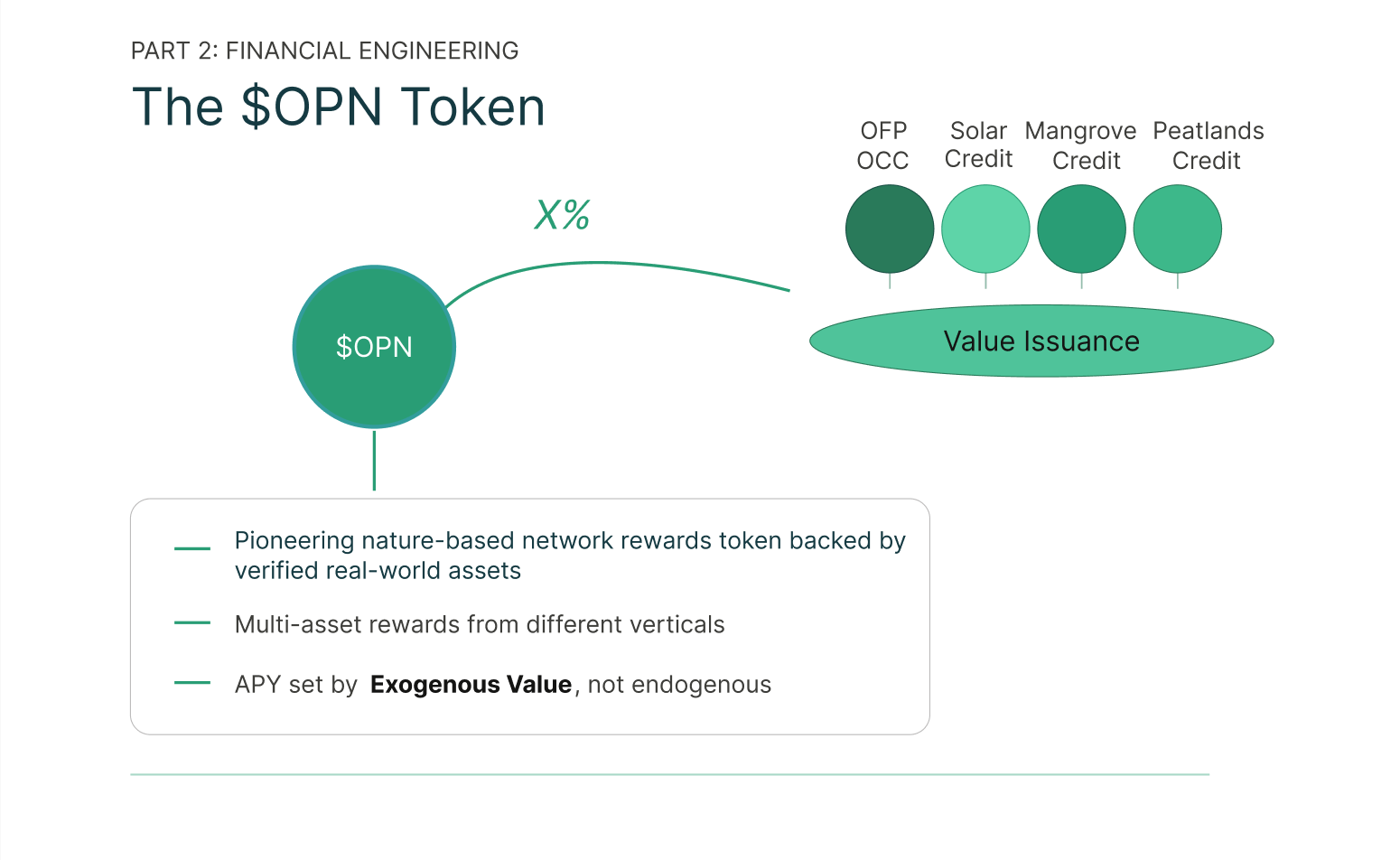
Over time, OFP will expand to encompass more than just the OCC. By locking $OPN, a user can receive various kinds of tokens created by dozens of verticals connected to OFP’s attestation mechanism. This ensures that the token’s long-term value is directly derived from and intricately connected to the amount and quality of verified nature-based assets on the protocol.
This makes $OPN a pioneering nature-based network rewards token. The $OPN token’s value is grounded in sustainable protocol incentives derived from real-world, verified natural capital assets. As these nature-based markets grow, the protocol is designed to reflect that growth through expanded network participation.
The initial supply of $OPN is 16mm tokens, while the long-term system design is intended to create a final capped supply of around 60mm tokens by 2050. The growth in network token parallels growth in network activity (# of Validators, # of projects, and # of verticals) in the system. This system, following the lead of Bitcoin and Ethereum, is designed to incentivize early adopters, from which equilibrium is discovered after reaching mass adoption.
Starting Supply Token Distribution and Protocol Inflation:
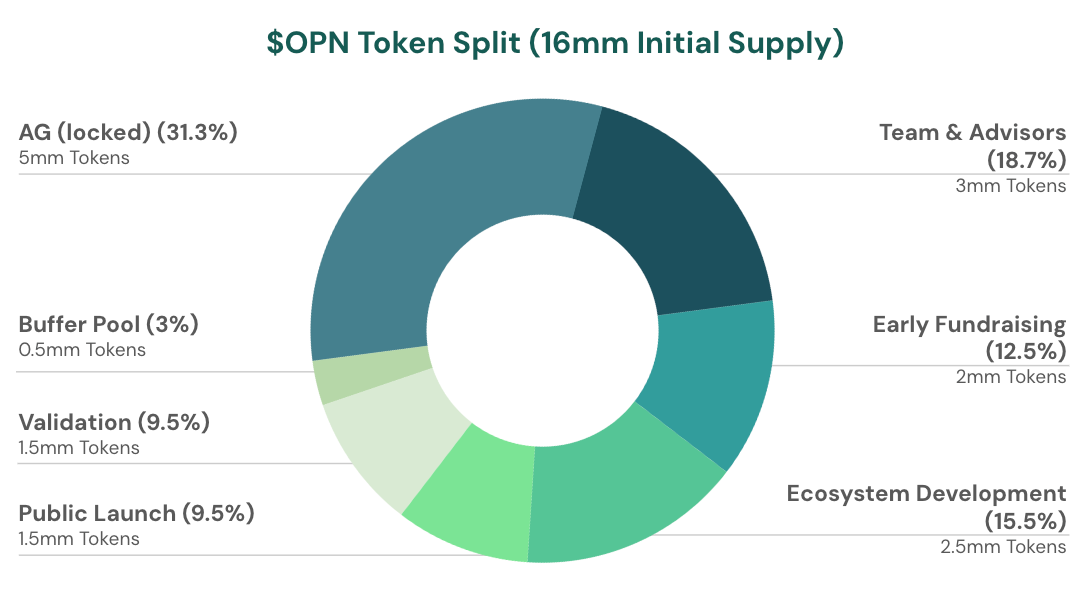
The underlying logic of the $OPN supply and issuance over time is a balancing act between jumpstarting the development of the system in its early years, from which the $OPN Token may become a scarce, anchor asset, grounding the natural capital economy on-chain, in later years.
Early Unbonding and Liquidity Provisions
